
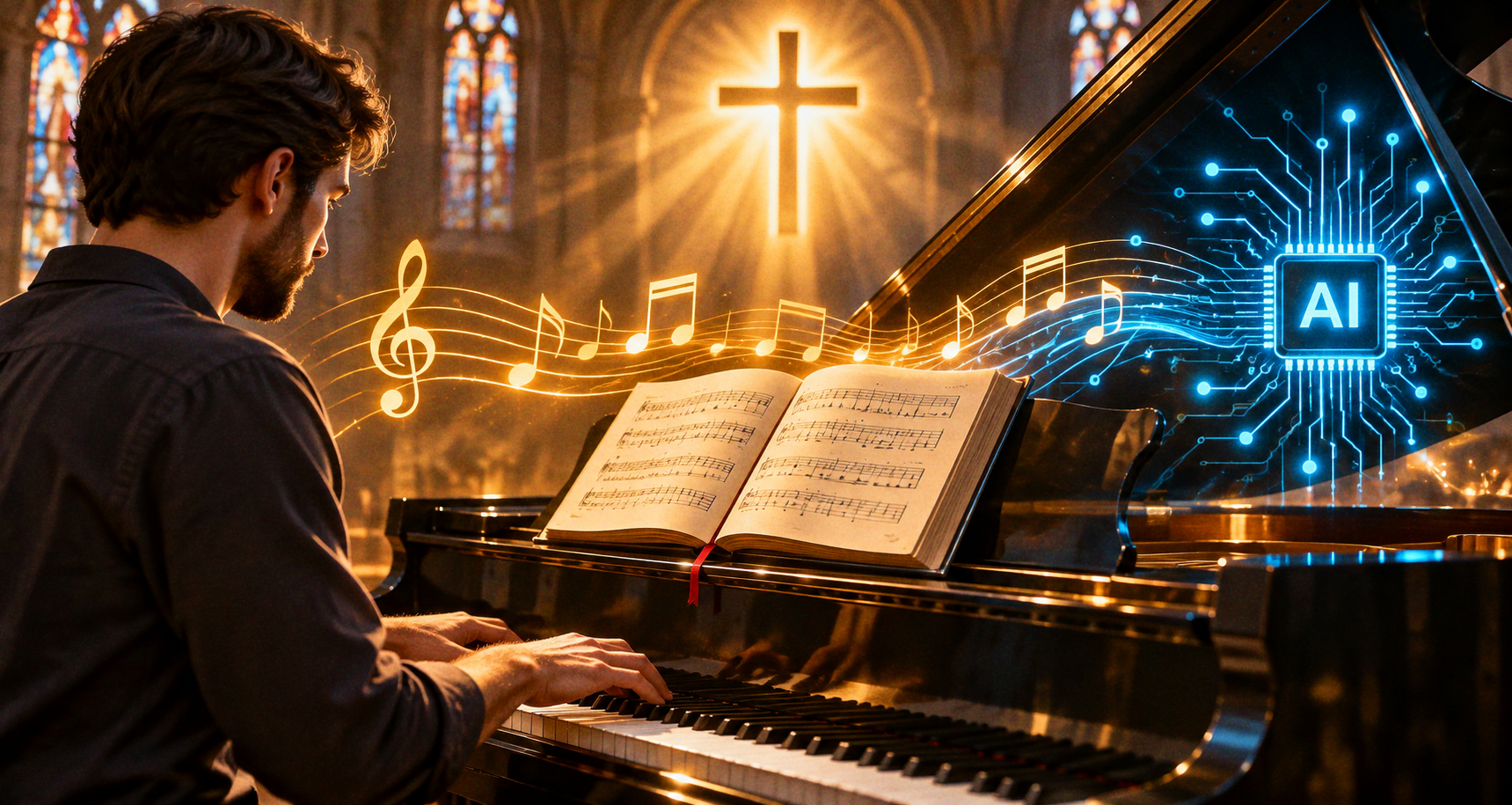
Artificial intelligence is changing music. Describe an arrangement, and moments later you can hear an orchestra that didn't exist before you typed. When that kind of power enters the world of sacred music, reactions get complicated fast — some people are excited, some are curious, some are uneasy, and some believe AI simply has no business anywhere near worship.
Those concerns are worth taking seriously. But so is the question underneath them. The issue isn't really "Was AI involved?" The better question is: how is it being used, what is it producing, whom is it serving, and does it honor God? That distinction shapes everything we do at aiHymnal.org.
The Concerns Are Real
Copyright, attribution, authenticity, the temptation to let automation replace human relationship — these are legitimate questions, not paranoia. Hymns aren't background noise. They carry theology, preserve Christian memory, and walk with us through prayer, grief, celebration, and hope. So "a computer generated it" can never be our standard for calling something good. But "a computer helped" doesn't automatically make something bad, either.
New Technology Always Looks Suspicious at First
We don't ask whether a piano is "artificial," yet it's an intricate human invention. Same with the pipe organ, the microphone, the electric guitar, even written musical notation — all tools built to extend what human hands and voices can do. Scripture doesn't shy away from this: Genesis 4 credits Jubal with the earliest stringed instruments and pipes, and Tubal-Cain with metalworking. Toolmaking isn't a 21st-century problem. It's as old as humanity. The real question has always been what we do with the tools we're given.
Craftsmanship Was God's Idea First
In Exodus 31, God calls Bezalel by name and fills him with wisdom, understanding, and skill to create artistic work for the tabernacle — in gold, silver, bronze, stone, and wood. God didn't object to human hands shaping creation's raw materials. He equipped people to do it well, in His service. Human creativity doesn't compete with God's — we create because He made us that way.
The pattern continues in 1 Chronicles, where the Levites praise God using instruments specifically "made for that purpose." Someone had to design them, build them, and learn to play them — human craftsmanship becoming an instrument of praise. Psalm 150 calls for trumpets, harps, lyres, strings, flutes, tambourines, and cymbals. The instrument itself isn't the worship. It facilitates it.
AI Is a Tool, Not a Destination
This might be the whole point. We don't gather to celebrate artificial intelligence. We don't sing to it, pray to it, or expect it to forgive sin or receive the Holy Spirit. However convincing a generated performance sounds, a machine is not a human being made in the image of God. Keep the tool in its place.
So what's it actually doing here? At aiHymnal.org, AI opens doors that an independent project couldn't otherwise afford — hearing a familiar hymn reimagined with a full orchestra and choir, or as an intimate acoustic arrangement, Southern Gospel, contemporary praise and worship, and more. The goal was never to make the AI impressive. It's to make the hymn meaningful — and accessible to churches and listeners who don't have an orchestra, a choir, or a recording budget.
The Human Role Changes — It Doesn't Disappear
A tool still needs direction. Someone has to choose the hymn, understand its message, catch a wrong note or a mangled lyric, decide when the harmony doesn't serve the text, and take responsibility for what gets published. Sometimes a musician plays and records a hymn first, just so the AI has something real to follow. What comes out afterward often needs heavy editing, retuning, remixing, remastering. The human role shifts. It never disappears.
A Simple Biblical Test
"Whatever you do, do it all for the glory of God." — 1 Corinthians 10:31
Whatever is a wide word. It's not enough to ask whether something is technically possible — we have to ask whether it glorifies God and loves our neighbor well (Matthew 22:37–40). Those priorities outrank novelty, efficiency, and even musical polish.
What This Means for Us
AI is not the message here. The hymn matters more than the technology used to record it, and the truth inside the hymn matters more still. That conviction comes with responsibilities: human oversight, real research instead of blind generation, respect for copyright, honest attribution, and a willingness to say no when a shortcut conflicts with these principles.
This technology will feel revolutionary right up until the next one arrives. What Christians need isn't excitement or fear — it's stewardship. The tool changes. The purpose never does: preserve the message, serve people well, and give the glory to God.