
I was working on this song when emotion struck.
I was in the middle of ordinary work, listening, adjusting, deciding whether a phrase was right. Then, without warning, I stopped being an editor and became a son. I remembered my father and the way he used to sing this hymn, "Far Beyond the Sun."
The Baritone
My father had a beautiful, strong baritone voice. When he sang, you knew he meant it.
He believed in the blessed hope: the second coming of Jesus. "Looking for the blessed hope and the glorious appearing of our great God and Savior Jesus Christ" (Titus 2:13). It was his favorite topic, and he preached on it for many years throughout Mexico. He preached it from pulpits, in small churches and large ones, and he sang it. This hymn was one of his favorites.
After a long battle with cancer, he went to rest fifteen years ago. He died holding the hope he had spent his life proclaiming: "For the Lord Himself will descend from heaven with a shout, with the voice of an archangel, and with the trumpet of God. And the dead in Christ will rise first.... and so we will be with the Lord forever. Therefore encourage one another with these words" (1 Thessalonians 4:16-18).
Hymn After Hymn
Our family worship was simple.
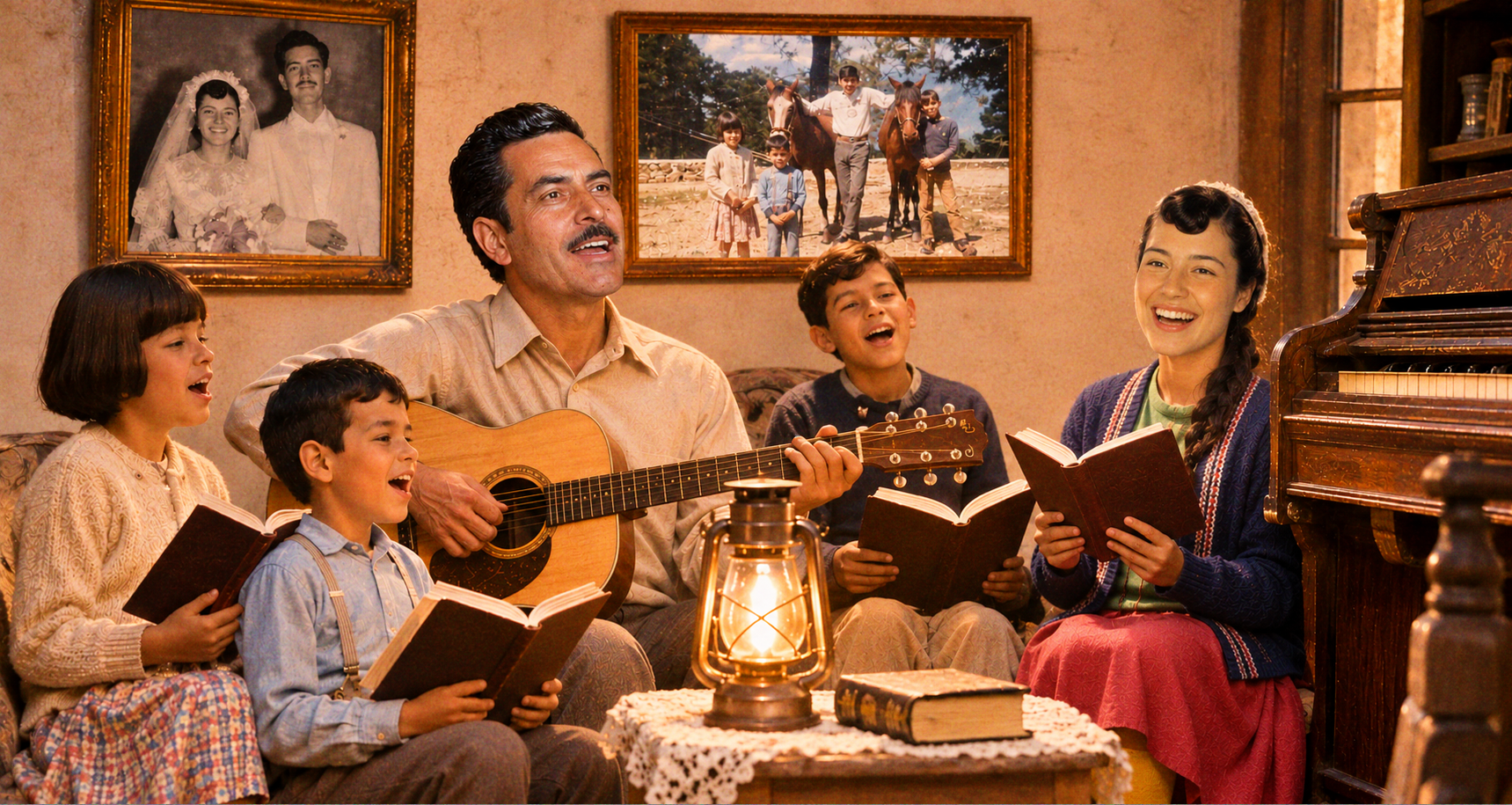
At night, he would take out his guitar and gather the whole family. We sang hymn after hymn. Then he told us a story from the Bible. Then we prayed, and we went to bed.
I didn't know it was a gift at the time. It was just what we did at the end of the day. But those evenings gave me a repertoire, a sense of how the Bible and music belong together, and a picture of what a home can be.
How I Learned Music
My musical education did not go the way a piano teacher would draw it up, and I say that as a music instructor.
When I turned 11, my father enrolled me in piano lessons. I loved the idea of playing the piano. I did not love spending countless hours on boring exercises.
Then we moved to another city, and the lessons ended.
Soon afterward, someone gave my father an old organ, the kind that makes sound when you pump the pedals with your feet to push air through it. My father, who loved carpentry, planned to turn it into a bookcase.
But my sister and I got to it first. We cleaned it, and somehow we made it sound. When my father came home and found us playing it, he changed his mind. The organ stayed an organ.
With no lessons and no pressure, I began learning on my own. I even wrote the music notes of my favorite songs in a notebook so that I wouldn't forget them.
Then my father bought me an accordion, and I learned a great deal from it about scales and harmony. Then he began taking me with him to churches far away, churches with no musical instruments at all. He chose the hymns, and I played them on the accordion while the congregation sang.
Looking back, I notice how much of my education was a father's quiet generosity. He gave me lessons when I wasn't ready for them. He let the lessons go when they weren't working. He gave me an organ instead of a bookcase. He gave me an accordion, and then he gave me a reason to play it: a congregation that needed someone to carry the tune.
The most important lesson I learned from those years is one I now try to teach: people learn music when it matters to them. Nobody can force the love of music into a child, but a hymn sung with a father can plant it.
The Question I Can't Quite Answer
Here is what I keep returning to.
How can an AI song make me cry?
I know how these songs are made. I know that AI music has no feelings of its own. The voice doesn't remember anyone. It hasn't lost anyone. It doesn't believe anything. And yet, as I listened to this beautiful song, I was moved.
I don't want to claim more than I know. But here is what I think is happening.
The emotion didn't come from the machine. It came from the hymn, and from my memories.
The words describe a hope my father lived and preached. The melody is one I heard in his voice, over a guitar, at the end of long days. The recording only gave all of that somewhere to land. A photograph has no feelings either, but it can bring the memory of a person back to you.
That doesn't make the tears cheaper. It means that music has always worked this way. A song carries what we put into it, and what others put into it before us. The meaning arrives through memory, through faith, through the people who taught it to us.
I take comfort in that. The tools may be new, but the thing that moved me is old: a hymn, a hope, and a father's voice.
Why This Hymn Belongs Here
Many of us have a hymn like this: one that isn't in the book but is part of the family. Someone sang it in a kitchen, in a car, in a church with a pump organ or no instrument at all. If it's lost, nobody will notice but us.
That is one more reason aiHymnal.org exists. Not to replace those voices, but to help carry what they sang.
If you have a hymn like this, I'd love to hear about it. Who sang it to you? Where? What did the song mean to them?
Why #700
Most of aiHymnal.org follows the Seventh-day Adventist Hymnal, and each of those hymns keeps its number from the book. Songs numbered 1000 and over are original, all-AI creations.
The numbers from 700 to 999 are for something in between: hymns from other hymnals. "Far Beyond the Sun" is not in the SDA Hymnal. But it has been sung for years in our churches, at camp meetings, and in family circles, and so it earns a special place.
I decided to make it the first in that range, because it is the song that taught me why those numbers should exist. Some hymns belong to a community, not to a book.
The Hope Behind the Song
My father believed that this world is not the end of the story. He believed it enough to preach it for decades, and to sing it until his last years.
I believe it too. And someday, if the hope he proclaimed is true, and I believe it is, I would like to hear his precious baritone voice again, with no recording needed.
Until then, I'll keep singing his song.
"Far Beyond the Sun" is #700 in aiHymnal.